


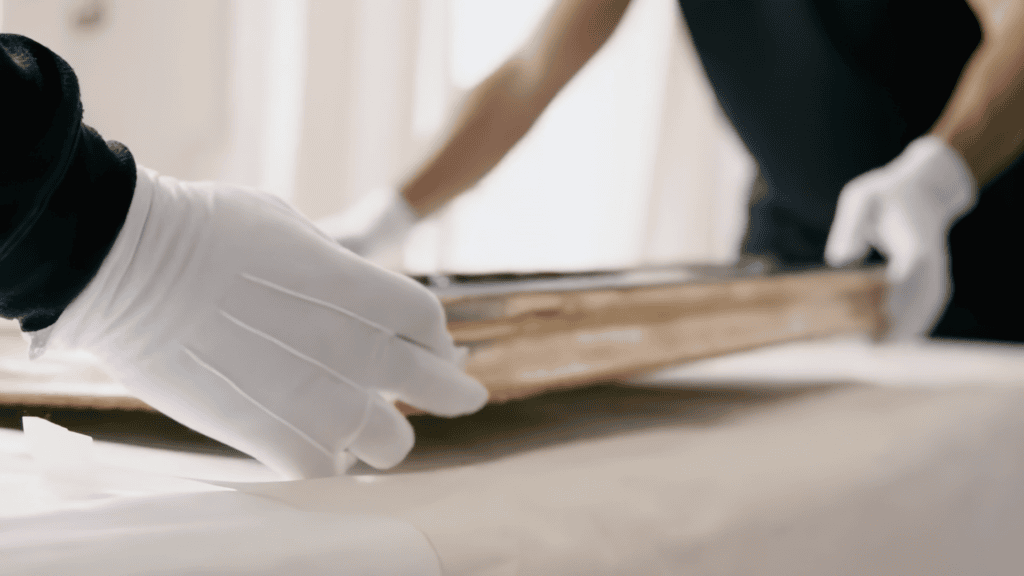
The transport of works of art is a delicate operation that requires expertise, rigor and anticipation..
Whether it is a master’s painting, a contemporary sculpture or a monumental installation, each movement must be precisely orchestrated to ensure the integrity of the transported pieces.
ESI MUSEUM guides you through the different phases of a professional art transport.
1. Preliminary assessment: identifying the specific characteristics of each work
Before any work is carried out, a technical audit is required. This diagnostic phase allows us to identify the specific characteristics of each work: dimensions, weight, fragility, heritage value and required conservation conditions.
Our experts carry out a detailed assessment of the condition of the item, which will serve as a reference throughout the operation. This photographic and written documentation guarantees traceability and allows the integrity of the work to be verified at each stage of the journey. For antique or particularly sensitive items, we also analyse their resistance to climatic variations and transport vibrations.
This assessment phase determines the type of packaging required, the most suitable mode of transport and any special precautions to be taken. It forms the basis for tailor-made logistics, designed specifically for each work of art.
2. Logistical preparation: planning ahead to ensure safety
Once the specific characteristics of the artwork have been identified, logistical planning comes into play. This crucial stage involves coordinating all parties involved: specialist transporters, exhibition curators, stage managers and, where applicable, customs officials and insurers.
The timing of transport is particularly important. We prioritise time slots that avoid heavy traffic and adverse weather conditions. For international transport, coordination with customs formalities requires several weeks, or even several months for certain destinations, of advance planning.
Authorisations and assurances
Certain works classified as historical monuments or subject to export restrictions require specific authorisations. ESI MUSEUM takes care of all these administrative procedures and ensures that each operation complies with the regulations in force. At the same time, the implementation of appropriate insurance cover protects the heritage and market value of the items being transported.
3. Bespoke packaging: protection at the heart of the process
The packaging constitutes the main rampart of the work against shocks, vibrations and climatic variations.
Our expert technicians design packaging solutions adapted to each type of work, using museum quality materials.
Our expert technicians design packaging solutions adapted to each type of work, using museum quality materials.
For paintings and framed works, we use padded crates with corner protection and anti-vibration support. Sculptures often require custom-made cradles that perfectly fit their shapes to avoid any pressure points. Monumental works may require the manufacture of complex structures, sometimes removable, to allow passage through confined spaces.
The materials used are selected for their chemical neutrality in order to prevent any reaction with pigments or substrates. Polyethylene foam, acid-free tissue paper, barrier films and air cushions make up our arsenal of protective equipment. For works that are sensitive to humidity, we include desiccant sachets and humidity indicators for continuous monitoring.
4. Handling: technical expertise at the service of delicacy
The moment of handling requires the utmost care. Our teams are trained in strict art handling protocols and use professional equipment: trolleys with soft wheels, suitable lifting straps and furniture lifts for large items.
Transfers are carried out according to pre-planned routes, limiting difficult angles and high-risk areas. For works of exceptional value or fragility, we deploy reinforced teams and proceed in successive stages, with breaks to check that the work is not under any stress.
In museums and listed buildings, our work complies with the architectural and heritage constraints of the site. The use of floor and wall protection preserves the integrity of the spaces we work in.
5. Transport: security and real-time tracking
The choice of transport vehicle meets strict criteria. Our air-conditioned lorries maintain a constant temperature and humidity level, which are crucial for the preservation of sensitive works of art. Reinforced suspension limits vibrations, while secure lashing systems prevent any movement during the journey.
For international or intercontinental transport, we coordinate the various modes of transport: road, air or sea, depending on the requirements in terms of time and preservation. Works transported by air are given priority treatment in freight areas dedicated to sensitive goods.
Full traceability
Each shipment is tracked in real time. Our geolocation systems allow us to know the vehicle’s position at all times, while on-board sensors record weather conditions and any impacts. This data is transmitted continuously, ensuring immediate response in the event of an anomaly.
Do you have a project involving the transport or installation of works of art?
Our teams support you in France and internationally.
6. Customs formalities: expert navigation through regulations
The crossing of borders constitutes a sensitive stage in the international transport of works of art. Regulations vary according to the countries of departure and destination, and certain works are subject to particular restrictions related to their age, origin or material.
ESI MUSEUM masters all customs procedures: ATA carnets for temporary exhibitions, export licences for cultural goods, CITES certificates for works incorporating materials of protected animal or plant origin. Our teams prepare the required documentation and coordinate with the competent authorities to streamline customs crossings.
This administrative expertise avoids prolonged fixed assets and ensures compliance with exhibition or delivery deadlines. For complex operations involving multiple countries, we orchestrate the entire document chain ensuring compliance with each jurisdiction crossed.
7. White glove delivery: refinement to the very end
Arrival at the destination marks the end of the process, but does not mean the end of our vigilance. Delivery is carried out according to the ‘white gloves’ protocol, which guarantees the highest level of care and discretion.
Our teams proceed with the methodical unpacking in the presence of the recipient, allowing immediate verification of the condition of the work by comparison with the initial report. Each step of the depackaging is given special attention, with packaging materials being gradually removed to avoid any sudden contact.
If necessary, we also ensure the positioning of the work in its final location: wall hanging for the paintings, installation on a base for the sculptures, setting up lighting for rooms requiring special scenography. This complete service transforms the reception into a serene moment, unburdened by any technical constraints.
8. Intermediate storage: a flexible solution
Some operations require temporary storage between two exhibitions, during renovation work or while awaiting sale. ESI MUSEUM has secure, climate-controlled storage facilities covering 20,000 m² in the Île-de-France region and on the French Riviera.
Our facilities offer optimal storage conditions: regulated temperature and humidity, air filtration, UV protection, anti-intrusion systems and 24/7 surveillance. Privatized areas ensure privacy for sensitive collections, while secure common spaces provide a cost-effective solution for ad hoc needs.
The proximity of our sites to Paris’s main exhibition venues and international airports (CDG, NCE) facilitates logistics operations and reduces delivery times.
A global orchestration at the service of excellence
The transport of works of art transcends simple logistics to become a know-how combining technical, anticipation and service. Each step, from initial assessment to final delivery, is part of a skill chain where excellence is not an option but a requirement.
ESI MUSEUM supports museums, galleries, private collectors and cultural institutions in their most ambitious projects. Our personalized approach adapts to each context: temporary international exhibition, loan between institutions, collection relocation or permanent installation.
Because each work carries with it a history, sensitivity and inestimable value, we implement the most rigorous protocols to ensure its integrity. From the first contact to the final reception, our commitment remains constant: offering exceptional logistics in the service of art and heritage.